Shopify Abandoned Cart Recovery: When to Use Email, WhatsApp and AI Calls
A strategy guide for Shopify merchants: decide which shoppers to contact, when email is enough, when a conversation helps, and how to measure recovery after discounts and costs.
A shopper adds two products to their basket, enters their details and reaches checkout. Then they leave. One customer may be surprised by shipping charges. Another may need help choosing a size. Someone else may have experienced a payment failure or simply put their phone down.
These situations produce a similar result in your dashboard: an unfinished purchase. But they do not need the same response. An effective abandoned cart recovery strategy starts by deciding which shoppers you can appropriately contact, what help they might need and which channel suits the conversation.
This guide helps Shopify merchants make those decisions. It covers email reminders, WhatsApp conversations and selected AI recovery calls, alongside ways to control discounts and measure results. The shopper journeys and financial examples are illustrative, not customer case studies or promised outcomes.
Understand what your store can actually recover
“Abandoned cart” and “abandoned checkout” are often used interchangeably, but the distinction matters. A visitor can add a product to a basket without giving you any contact details. That basket may be abandoned, but you cannot assume you have a suitable way to follow up.
An abandoned checkout involves a shopper who has progressed further towards buying. The information available determines what your recovery tools can use. Separate anonymous visitors, identifiable shoppers with an appropriately permitted contact channel, and checkouts that should be excluded from recovery.
Shopify documents its abandoned-checkout email automation separately from general cart activity. Supported sales channels and delivery conditions affect which checkouts receive an email. Consult Shopify’s automation guide for the current behaviour.
Your reporting should distinguish total abandonment from contactable opportunities. Otherwise, a large abandoned-cart count can create an unrealistic expectation about how many shoppers a recovery campaign can reach.
Investigate checkout problems before adding reminders
More follow-ups will not fix a checkout that repeatedly prevents customers from paying. Start by reviewing recent abandoned checkouts. Look for recurring patterns: the same product, shipping destination, payment method or stage of checkout.
Complete a purchase journey yourself on mobile. Can customers understand the final price, delivery options and return terms without searching through several pages? Do shipping charges appear unexpectedly? Are sizing instructions clear? Does a failed payment produce an understandable next step?
Shopify lets merchants inspect payment events associated with abandoned checkouts. Those details can help distinguish a payment issue from a shopper who simply stopped buying. See Shopify’s payment-event guidance.
Record what you find. If several shoppers encounter the same obstacle, fixing it may be more valuable than sending another reminder. Give your support and merchandising teams those findings so the recovery programme also improves the buying experience.
Choose a channel for the situation
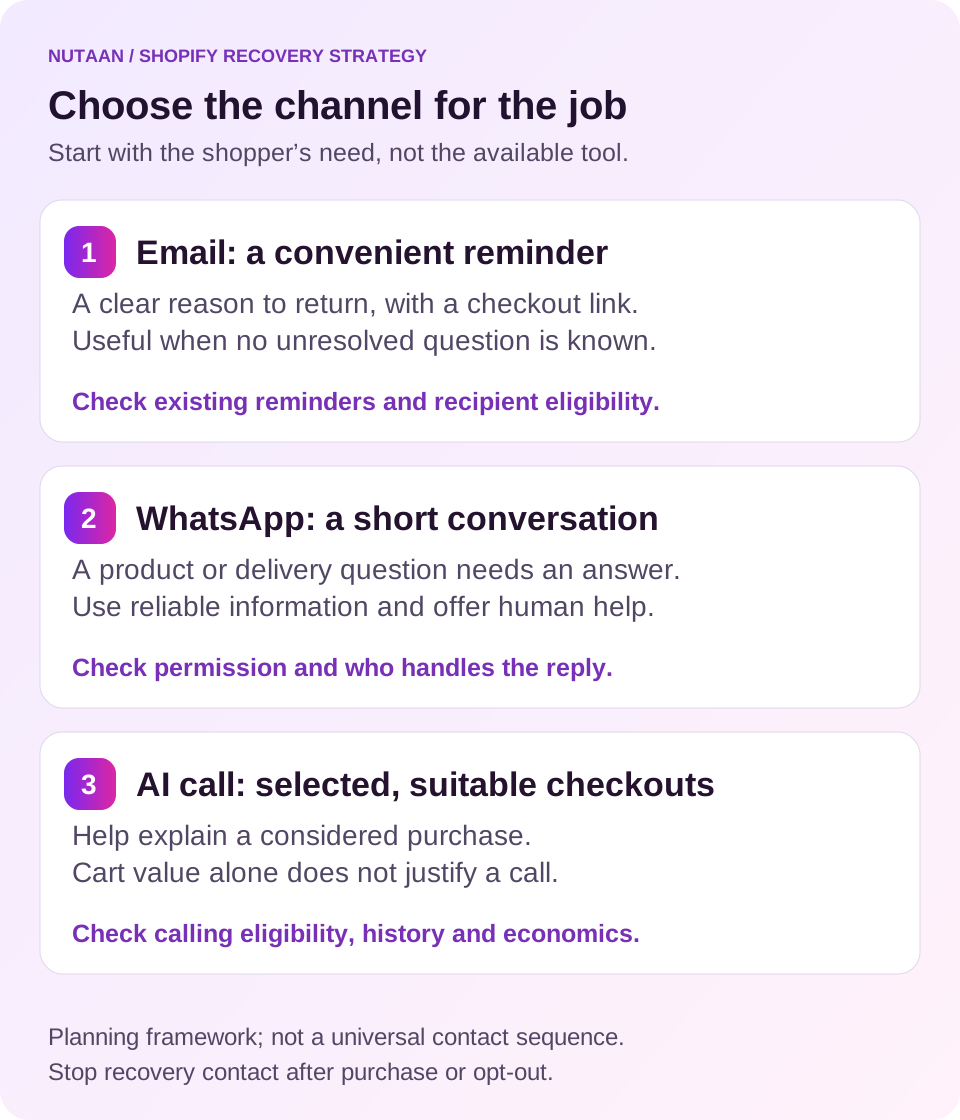
Email, WhatsApp and phone calls serve different purposes. Email gives customers a familiar reminder they can open when convenient. WhatsApp can support a short exchange where the shopper wants clarification. A phone conversation may suit a selected checkout with a question worth discussing.
Use the following comparison as a planning framework, not a universal rule. Cart value matters, but permission, previous communication, product margin and customer preferences matter too. A higher-value basket does not automatically justify a phone call.
| Shopper situation | Possible next step | Check first |
|---|---|---|
| No known question; eligible for a reminder | Existing automation and recipient eligibility | |
| Needs a short product or delivery answer | WhatsApp conversation | Contact permission and reliable answers |
| Selected higher-value cart with a supported question | Consider an AI call | Calling eligibility, margin and contact history |
| Payment failed | Investigate the payment issue | Payment events and supported next steps |
| Already purchased or opted out | Stop recovery contact | Purchase and exclusion updates |
Use email for a clear return path
An abandoned checkout email should make returning easy. Customers need to recognise the store, understand what the message concerns and find the checkout link quickly. A complicated promotional layout can distract from that purpose.
An illustrative message might say: “Still considering your order? Your selected items are waiting at checkout. If you have a question about delivery or sizing, reply and our team can help.” A clear “Return to checkout” action then gives the shopper a useful next step.
Product information provides context, but avoid promises about stock or delivery that your store cannot support. Check the email automation already running before adding another recovery tool. Decide which system owns the first reminder and how later contact will account for it.
Keep email as a defined part of the overall sequence. This article does not assume Nutaan replaces your email service or that independent tools automatically share their contact history.
Use WhatsApp when a shopper needs an answer
WhatsApp abandoned cart recovery can be useful when a shopper has an appropriate contact relationship with your business and a question that fits a short conversation. The message should identify your store and offer relevant help.
For example: “Hi Maya, this is the team at Example Store. Would you like help with the size or delivery details for the jacket you selected? You can also return to checkout here.” This is illustrative copy, not a template approved for every campaign or market.
The operational question comes after the reply. Can your workflow answer accurately? Can it hand the conversation to someone who can help? Establish contact permissions, applicable messaging requirements, opt-out handling and responsibility for questions the assistant cannot resolve.
Treat an uncertain answer as a support task. Repeating the checkout link will not resolve a sizing question. Review unanswered questions regularly: they can reveal gaps in product pages that affect many more shoppers than those who reply.
Reserve AI calls for suitable conversations
A call asks for more attention than an email. It should have a clear purpose. A shopper evaluating an expensive item may want to understand compatibility or delivery options. A short conversation may help when the assistant has reliable information and calling is appropriate.
The assistant should identify the business, explain why it is calling and establish whether the shopper wants help. It should answer supported questions, respect a refusal and offer a route back to checkout when appropriate. Unverified delivery promises or discounts outside your rules create avoidable problems.
Use economics and customer needs together when deciding which carts qualify. Then check actual conversations for accuracy and usefulness. For the detailed eligibility, conversation and checkout mechanics, read How AI Recovery Calls Work on Shopify. That article explains the operational workflow; this guide focuses on choosing and coordinating channels.
Build one sequence across your tools
A store can unintentionally contact the same shopper through several independent automations. An email tool sends a reminder, a WhatsApp workflow starts separately, and a calling system schedules a call. Each system seems reasonable on its own, but the customer experiences all three.
Design the overall sequence before activating individual channels. Decide which system starts recovery, what makes a checkout eligible for escalation and how completed purchases stop future attempts. Include limits on contact frequency and a shared approach to opt-outs.
Your strategy might begin with an existing email reminder and consider conversational contact only for a selected group of unresolved checkouts. That is a strategy example, not a claim that every app provides automatic coordination.
Confirm which purchase events, exclusions and contact histories your connected tools actually share. Where coordination is unavailable, configure conservative limits. Test purchase and opt-out scenarios across the whole setup before expanding the audience.
Test the strategy with three shopper journeys
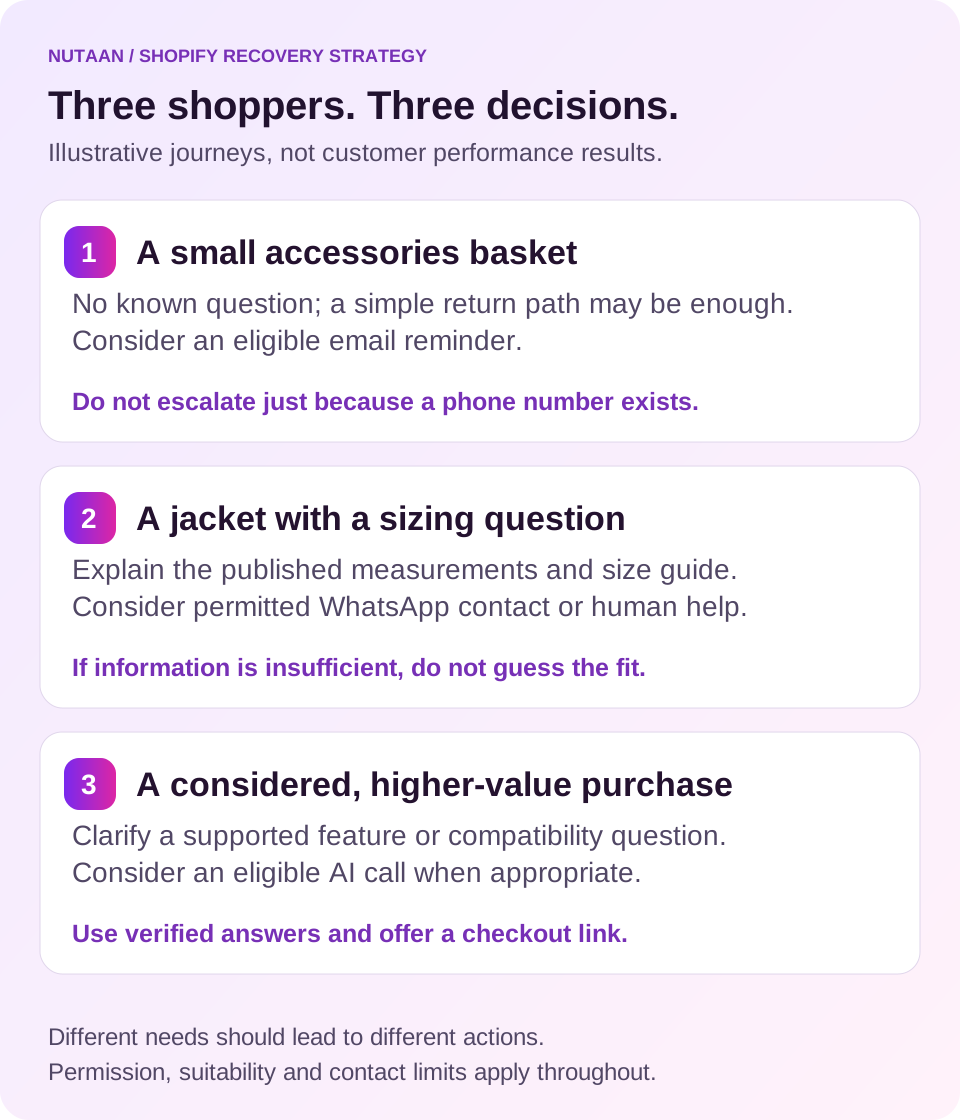
First, consider a small accessories basket with no known question. An eligible email reminder may be sufficient. Adding a call could cost more attention and effort than the purchase justifies. Avoid escalation simply because another contact method exists.
Second, consider a shopper unsure whether a jacket fits their measurements. A permitted WhatsApp conversation could explain the published size guide. If the information does not resolve the question, route it to your team rather than invent a recommendation.
Third, consider a larger purchase requiring clarification about a documented feature. An eligible AI call may help explain that feature and offer a return link. The assistant should know which questions require human help.
These examples deliberately lead to different decisions. Use them in a team walkthrough: identify the evidence needed, the permitted channel, the answer source and the stopping condition. Segmentation should change what happens to the customer.
Protect margins before offering discounts
A discount can encourage a purchase, but it changes the economics of recovery. On ₹3,000 of merchandise, a 10% discount removes ₹300 from the sale before fulfilment, payment processing, communication costs or returns. This is an illustrative calculation, not a performance benchmark.
If the shopper only needed a sizing answer, that discount may have been unnecessary. Decide which products can support offers, the maximum amount and whether promotions can be combined. Consider how the rule behaves when prices or stock change.
An example policy is to answer the question first, then consider an offer only when price is the obstacle and the products meet margin requirements. Give the person responsible for pricing a chance to review those limits.
A rise in discounted orders does not establish profitability. Review contribution after costs and compare the result with what would likely have happened without the additional recovery contact.
Measure orders, costs and incremental results
Messages sent and calls attempted describe activity. They do not establish business value. Track eligible checkouts, unique shoppers contacted, conversations reached, completed orders and associated revenue as separate stages.
Define every percentage clearly. Contacted-checkout conversion rate equals completed orders in the contacted group divided by unique eligible checkouts contacted, multiplied by 100. If 20 of 200 contacted checkouts become orders within your measurement window, the rate is 10%. That illustrative result does not prove the contact caused every purchase.
For a stronger evaluation, compare similar groups, keeping a randomly selected group outside the additional treatment where practical. Keep other conditions comparable and record your attribution window.
Include discounts, communication costs, product costs, fulfilment and returns. Attributed recovery revenue is useful operationally, but incremental contribution asks whether the programme created additional value. Investigate weak results rather than simply increasing message volume or calling more shoppers.
Keep COD confirmation separate from recovery
Cash-on-delivery confirmation concerns an order that already exists. Abandoned checkout recovery concerns a purchase that has not been completed. A confirmed COD order should not automatically count as a recovered checkout.
If you use both workflows, maintain separate triggers and outcomes. Recovery reporting concerns completed purchases; confirmation reporting concerns whether a customer confirms, declines or needs help with an existing order. Clear separation helps your team interpret results and prevents confusing follow-ups.
Where Nutaan fits into the strategy
Nutaan Commerce provides a documented Shopify recovery workflow using configured WhatsApp contact and AI calls. It can sit alongside your existing email automation. Available features depend on your plan, connected services and configuration; independent tools should not be assumed to coordinate automatically.
Before enabling contact, confirm your eligibility rules and available features. Start with a defined checkout segment, inspect conversations and improve the answers that repeatedly need human support. Expand when the customer journey is useful and the results make commercial sense.
Explore Nutaan’s Shopify abandoned cart recovery page for product and setup information. Use the AI recovery calls guide for mechanics, the checkout workflow guide for sequencing and stop rules, and the ROI guide for contribution and holdout measurement. For WhatsApp-specific setup and message intent, use the dedicated WhatsApp recovery page.
Frequently asked questions
What is the best channel for Shopify abandoned cart recovery?
There is no universal winner. Email suits a convenient reminder, WhatsApp can support a short exchange, and selected AI calls can address supported questions. Choose using permission, customer needs, contact history and costs.
Can abandoned cart recovery work without discounts?
Yes. A shopper may need a sizing answer, delivery information or help understanding a payment issue. Resolve that obstacle before assuming a lower price is necessary.
Does a recovered-order report prove that recovery caused the sale?
Not by itself. Some shoppers would have returned without contact. Define the measurement window and use a suitable comparison group where practical to estimate the additional effect.
What should I check before choosing an abandoned cart recovery Shopify app?
Review supported channels, checkout compatibility, permissions, stopping rules, reporting, pricing and human handoff. Test the customer journey and how the workflow handles purchases, opt-outs and unavailable products.
Written by the Nutaan team. This strategy guide draws on Shopify’s published documentation and Nutaan Commerce’s documented recovery workflow. Shopper journeys and financial examples are illustrative, not customer results. Features depend on plan and configuration. Reviewed 9 November 2026.