Reducing COD RTO With Confirmation Calls
A confirmed call is not a delivered parcel. Here is how to use order checks, address read-backs and callbacks to make better dispatch decisions—and measure whether they reduce COD RTO.

Return-to-origin is an outcome at the end of a delivery journey. A confirmation call happens near the beginning. The useful question is not whether an AI can persuade someone to say yes. It is whether the information collected before dispatch helps your team avoid an unwanted or undeliverable shipment without cancelling good orders.
For an Indian Shopify COD store, that means treating confirmation as an operational check. The customer may still want the order but have entered the wrong flat number. They may need a callback after work. They may have placed a duplicate order. Each situation needs a different next step, and none is resolved by putting every customer into a single confirmed/not-confirmed bucket.
This guide explains the review process. The COD confirmation page covers the configured Nutaan workflow, plans and setup. The examples below are fictional and should not be read as measured merchant results.
Start with the orders that are actually COD
Use the order payment method and current state, not a guess based on the buyer’s location. A prepaid order with a delivery question is not a COD verification task. An abandoned checkout is not yet an order at all. Separate those queues before scheduling any contact.
Shopify treats cash on delivery as a manual payment method. Its manual payments guide explains the unpaid-order state and marking payment after collection. A successful confirmation call should not mark an unpaid COD order as paid.
Build an eligibility view containing the order ID, creation time, current financial and fulfilment state, contactability and any cancellation or prior verification. Recheck the record before contact so a late cancellation or already-dispatched order does not enter the wrong journey.
Ask about intent, amount and the complete address
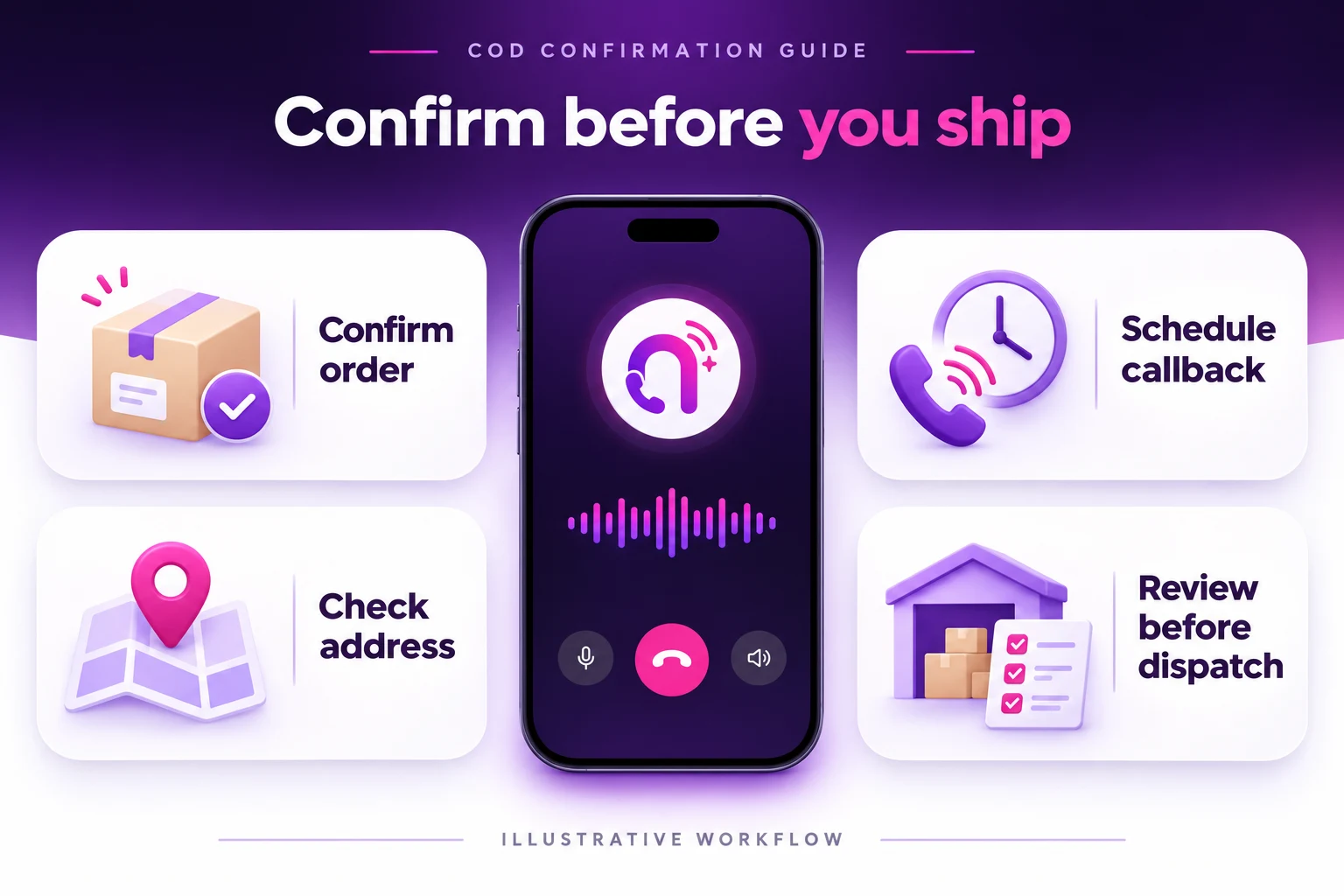
Keep the opening short: identify the store, explain the order-related purpose and check whether this is a suitable time. Read back the items and amount the customer expects to pay. Ask whether the order is still wanted; do not bury that question inside an upsell.
For the address, a partial correction is a clue rather than a finished verification. If the customer says “B-504, not B-405,” read the corrected address back as a whole and capture what was actually agreed. Check the recipient name, flat or building, locality, city and PIN where appropriate. Avoid asking for unrelated personal information.
A verbal address confirmation does not establish courier serviceability. If a change affects the delivery zone, PIN or shipping price, send it for review. Never invent a delivery date or promise that a courier will make an exception.
Treat a callback as a commitment, not another failed call
“Call after six” is useful information. Record the requested time, the relevant timezone and the permitted contact window. If the request cannot be honoured, flag it for the team instead of silently moving it to the next retry slot.
Set an attempt cap and a gap between attempts. The right policy depends on your fulfilment cut-off and customer context; a fixed five-attempt sequence is not automatically appropriate for every store. An unanswered order should remain unverified, with a visible owner for the decision to wait, contact through another permitted channel or cancel under the store policy.
Make the review queue actionable
The fulfilment team needs the latest result, the reason, any changed fields and the next action. A transcript can help resolve ambiguity, but staff should not have to listen to every call to discover that an address needs attention.
Keep customer-requested cancellation distinct from a technical failure. Keep no answer distinct from explicit refusal. A failed integration must not produce the same operational signal as a customer saying the order is unwanted.
| Result | Suggested review action |
|---|---|
| Confirmed | Check current order state and courier serviceability before dispatch. |
| Address correction | Review the full corrected address and any zone or cost change. |
| Callback requested | Respect the agreed time within permitted contact hours. |
| No answer / unclear response | Keep unverified; follow the store’s documented review policy. |
| Customer cancellation | Review and apply the cancellation policy; do not keep pitching. |
A hypothetical address-check example
Consider an unpaid ₹1,799 COD order awaiting fulfilment. The customer confirms the amount but says the building number is wrong. The agent captures the correction and reads back the complete address. The result becomes an address-review task, not a paid order and not an unconditional instruction to ship.
The team checks that the corrected address is serviceable and still belongs to the intended delivery area. If it is, staff approve dispatch through their normal process. If the customer asks for a different city or cannot confirm the PIN, the order waits for a person to resolve the change.
In a second example, the customer says they are in a meeting. A callback is scheduled for the requested period, subject to the store’s permitted hours. Calling repeatedly before that time would undermine the information the first call collected.
Measure delivered orders, cancellations and RTO together
Define RTO consistently—for example, returned-to-origin shipments divided by COD shipments dispatched in a comparable cohort. Wait long enough for delivery attempts and returns to settle. Comparing last week’s newly shipped orders with last month’s completed delivery cohort will distort the result.
Track pre-dispatch cancellations, delivery rate, address corrections, callback completion and customer complaints alongside RTO. A lower RTO rate achieved by holding or cancelling too many genuine orders is not automatically a better business outcome.
Use a suitable comparison group where feasible and include freight, return freight, handling, stock delay, call usage and staff review time. The recovery ROI guide explains contribution and baseline thinking; use the same discipline when evaluating COD operations.
Launch with a small, inspectable pilot
Before live contact, confirm the permitted purpose and contact method, the calling connection, language, script, contact hours and opt-out handling. Test a cancellation, a changed address, an unanswered call, a callback and an integration outage. Installing the app alone is not a configured verification programme.
Nutaan Commerce Growth is $500 USD per 30 days and includes COD verification by email. Enterprise is $1,200 USD per 30 days and includes AI COD calling. Both support up to two Shopify stores per Commerce account. Confirm calling usage and connected-service costs before launch; existing contracted customers retain their agreed arrangements.
Use the Shopify COD confirmation overview for setup details, or book a demo to walk through a sample order and the review queue with your team. Bring actual order-state and courier questions rather than a target RTO percentage to promise.
Frequently asked questions
Does a confirmed COD call guarantee delivery?
No. It records intent and delivery details at a point in time. Serviceability, delivery attempts and later customer decisions still affect the outcome.
Should no-answer orders be cancelled automatically?
Use a documented store policy and human review. No answer is not the same as a customer asking to cancel.
Written by the Nutaan team from the product workflows and public references linked in this guide. Examples are hypothetical, not merchant results. Configuration, permissions, plan and connected services determine availability. Reviewed 10 November 2026.