
Nutan
She was told at fourteen that she did not have the face for the screen. She went on to win five Filmfare Best Actress awards — a record that stood for decades — by refusing, every few years, to stay the actress she had already been.
We took our name from that. Timeless, yet always becoming new.

Two songs, and a feeling worth keeping.
Thirty seconds of each. The waveform is the recording itself — press play.
The warmth and charm of an old Indian evening — light on its feet, and completely unhurried.
- Music
- Ravi
- Lyrics
- Majrooh Sultanpuri
- Voices
- Kishore Kumar & Asha Bhosle
Devotion, and the kind of attention that treats another person as the whole of your day.
- Music
- Ravi
- Lyrics
- Rajendra Krishan
- Voices
- Lata Mangeshkar
Both songs are used here as thirty-second excerpts, in tribute. All rights in the compositions, lyrics, performances and recordings remain with their owners and the original music label. Nutaan claims no rights in them.
Avishek Bhattacharjee, the founder of Nutaan, has always been deeply fascinated by the beauty of old Indian culture — especially its music, poetry, and the emotions they carried.
When he first imagined what Nutaan should feel like, his mind naturally went back to the timeless music he loved growing up.
Two songs stood out in particular: “Yeh Raaten Yeh Mausam, Nadi Ka Kinara” from Dilli Ka Thug and “Tum Hi Mere Mandir, Tum Hi Meri Pooja” from Khandaan.
One captures the warmth and charm of an old Indian evening; the other carries a feeling of devotion and deep emotional connection.
That combination became part of the spirit behind Nutaan — taking the warmth, simplicity and soul of something timeless, and bringing it into a completely new world of technology and AI.
Nutaan isn’t just about building an AI employee. It’s about bringing a little bit of that old Indian warmth into every conversation.

Not a career. A series of reinventions.
The name comes from the spirit of Nutan — from नूतन, which means new.
Her story was never really about stardom. It was about reinvention. She was rejected early and publicly, changed herself on her own terms, took roles nobody expected her to take, and kept becoming someone new without ever losing who she was. That is a rarer thing than success, and it is what we wanted the name to carry.
Timeless, and always becoming new. Both halves matter, and the second one is the difficult half.
A life, in brief

Born in Bombay
Daughter of the actress Shobhana Samarth and the director Kumarsen Samarth. Cinema was the family trade before it was ever her choice.
A debut at fourteen
She appeared in Hamari Beti, directed by her mother. The response was unkind — much of it about her face rather than her work. She was still a child.
Switzerland
Sent to a finishing school near Lausanne. She came back composed and entirely self-possessed, and the industry that had dismissed her had to look again.
Seema
The performance that settled the argument. It won her the first of her Filmfare Best Actress awards, at nineteen.
Dilli Ka Thug
She sang “Yeh Raaten Yeh Mausam” in a swimsuit, on screen, in 1958 — a choice Hindi cinema had no precedent for and no vocabulary to discuss.
Sujata, and a marriage
She married Lt. Cdr. Rajnish Bahl of the Indian Navy, and took the lead in Sujata, a film about caste that most of the industry would not have touched.
Bandini
Bimal Roy’s prison drama, and the performance most often named as her finest. Restraint doing the work that noise usually does.
The hardest years
A dispute over her own earnings put her in court against her mother. It cost her the family around her, and she kept working through all of it.
Padma Shri
Recognised by the Republic, twenty-four years after being told she did not have the face for the screen.
A fifth Best Actress
Main Tulsi Tere Aangan Ki brought a fifth Filmfare Best Actress award — a record that stood, unmatched, for decades after her death.
21 February
She died of cancer, aged fifty-four, still taking roles. The work she left behind is why anyone still argues about who the best of them was.
There is no easy stretch to point at.
The filmography reads like an unbroken run of wins. Underneath it: written off at fourteen for her face, and later in court against her own mother to get her own earnings back. She won her independence and lost her family in the same motion, and went to work through all of it.
She married a naval officer in 1959 and, unlike almost every leading woman of that decade, did not disappear — two more Best Actress awards came after motherhood. A swimsuit on screen in 1958. An untouchable woman in Sujata a year later. She was arguing with the room, decades early.
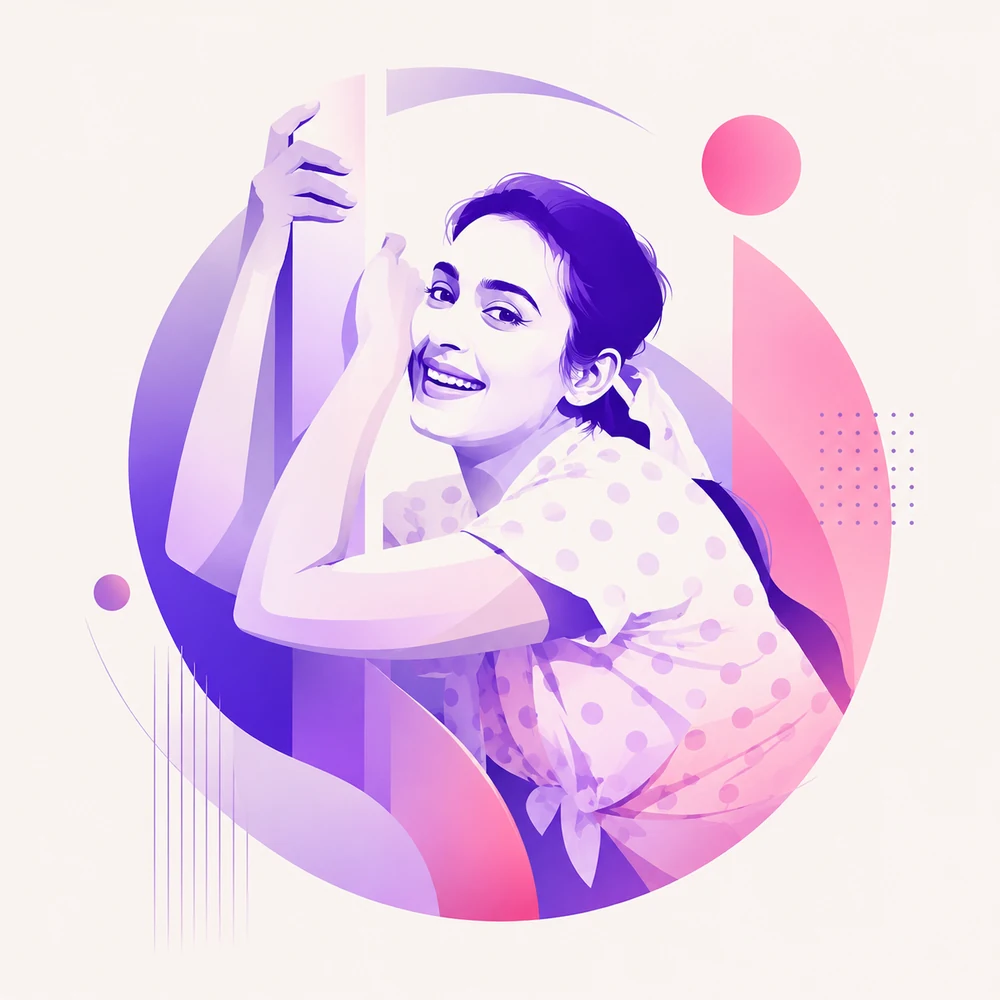
Something new, out of what already exists.
AI is, at bottom, the making of something new out of what already exists. That is also a fair description of what she did with a form that had been handed to her fully assembled.
Nutaan is an AI employee that speaks, listens, understands, follows up, qualifies, schedules, and works beside people rather than instead of them. We wanted its name to have an Indian soul without sounding like a museum piece.
Rooted in where we come from. Built for where the world is going. That is what the name means to us — new, but not cut off from what it came out of.
Rooted in where we come from.
Built for where the world is going.
In memory of Nutan · 1936–1991
This page is not a product page, and there is nothing to buy on it. If you would rather hear what the name went on to build, that is one link away.
See what Nutaan does