How to Measure AI Cart Recovery ROI
Recovered revenue is a starting point, not profit. Compare eligible shoppers against a holdout and include subscription, calling, messaging, discounts and returned orders before judging the result.
A checkout completes after an AI call. The dashboard attaches the order to the recovery journey and the revenue looks encouraging. But the shopper may have returned anyway, the discount may have consumed the margin, or the order may later be refunded. Revenue attribution alone cannot answer whether the programme earned its cost.
Measure AI cart recovery ROI as the additional contribution created by the programme after its additional costs. That requires a baseline, a consistent eligibility rule and enough time for delivery and returns. It does not require an impressive percentage on the first week’s dashboard.
This is a measurement guide, not a merchant case study. Every number in the worked example is hypothetical. Use the Shopify recovery page for the actual offer and setup requirements; do not treat the example costs below as Nutaan’s rate card.
Define the decision you are evaluating
Choose a clear question: does a permitted call improve contribution on selected high-margin abandoned checkouts, compared with the recovery process already in place? That is narrower and more useful than asking whether all recovery activity works.
Write the eligible population before starting. Include market, order-value or margin threshold, contact availability, permission, stock status and exclusions. If the called group contains only the most promising shoppers while the comparison includes everyone else, the difference will not isolate the effect of the call.
Decide whether the experiment measures an added calling layer or an entire email/WhatsApp/calling programme. Keep the baseline channel treatment consistent with that decision.
Keep a comparable holdout
Where appropriate, randomly assign eligible records or customers to a treatment and a holdout before contact. Keep a stable assignment when the same shopper creates another checkout. The holdout receives the agreed baseline experience rather than accidentally entering a different recovery campaign.
Record the same conversion window for both groups. Compare rates rather than raw order counts if the group sizes differ. Do not switch assignment after seeing a shopper reply or purchase.
Small samples can be noisy. State the eligible count, completed-order count, observation dates, assignment method and limitations. A short pilot is useful for checking the workflow, but it may not establish a reliable business uplift.
Convert order value into contribution
Start with net sales after discounts, cancellations and refunds. Deduct cost of goods, payment costs, variable fulfilment and shipping subsidy. Include expected returns only provisionally; replace estimates with actual outcomes when the cohort has matured.
For COD, distinguish an order placed from a parcel delivered and cash collected. Include forward and return freight and review the COD RTO guide when confirmation is part of the programme. Otherwise, a large number of low-quality COD orders can make the revenue metric look better while contribution gets worse.
Avoid counting a discount twice. If contribution per order is already calculated after discount, do not subtract the same discount again in programme costs. Apply the same rule to shipping and returns.
Include the costs outside the subscription
List the subscription allocation, connected calling usage, phone-number rental, destination charges, messaging delivery, email transport, staff review and setup work. Confirm what is included in the commercial agreement so the model neither hides a cost nor duplicates one.
For WhatsApp, use the actual market/category delivery rate and connected-service invoice. For calls, use billed usage and the relevant destination rate, not a guessed average call duration. Capture failed attempts or minimum-billing effects where your agreement charges for them.
Public Shopify plans are Growth at $500 USD per 30 days and Enterprise at $1,200 USD per 30 days. AI recovery/COD calling and advanced WhatsApp automation are Enterprise features. Both permit up to two Shopify stores per Commerce account. Existing contracted customers may have different agreed billing; do not assume a public plan replaces that arrangement.
For a shared two-store subscription, state how the fee is allocated. Report both programme-level economics and the full-account view. A generous allocation can make one store look profitable while hiding the overall cost.
Worked example: attributed sales versus incremental profit
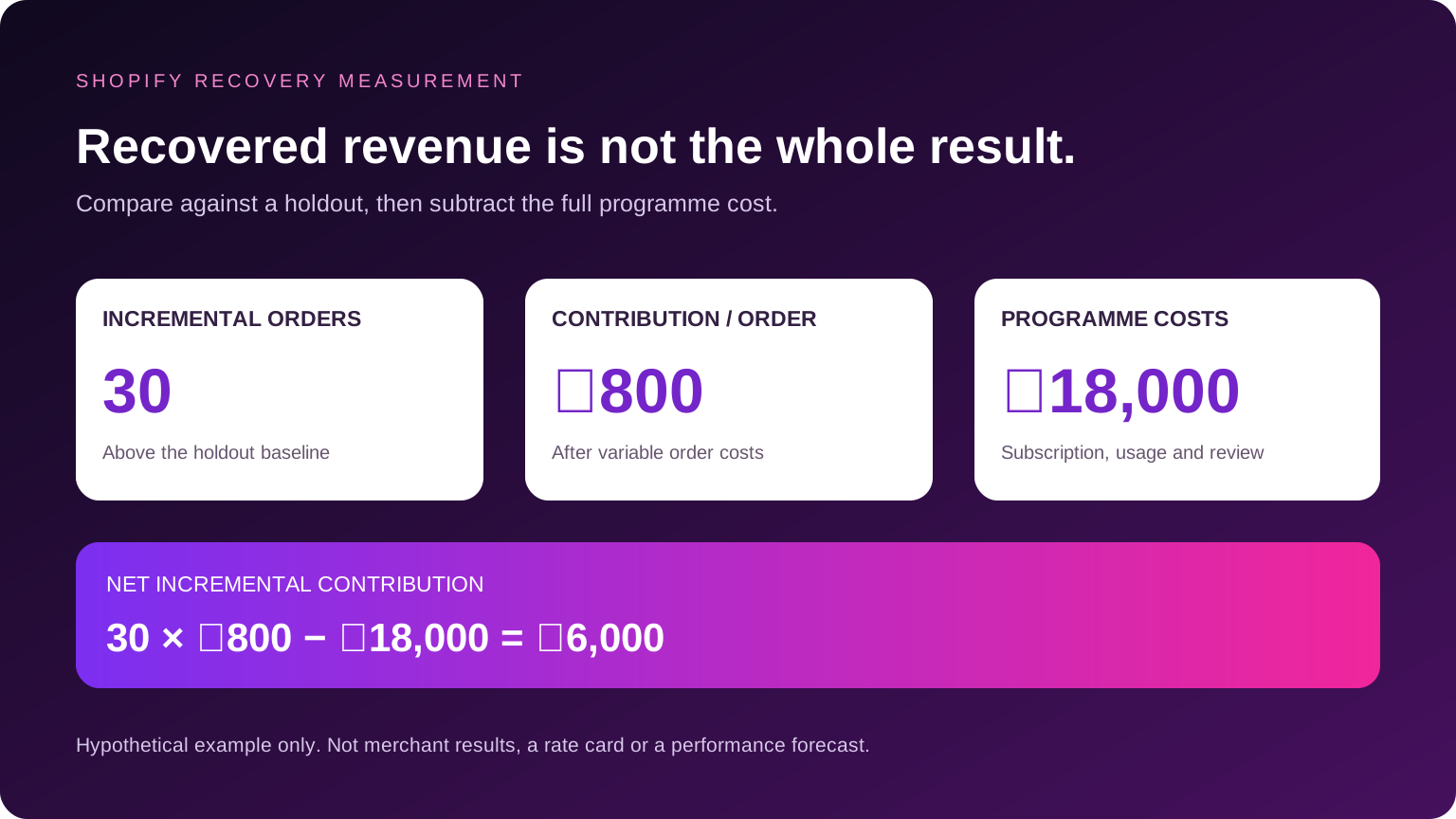
Assume a fictional pilot assigns 1,000 comparable eligible checkouts to contact and 1,000 to the baseline holdout. Within the same observation window, 90 treatment shoppers and 60 holdout shoppers complete an order. Assume ₹800 contribution per completed order after discounts and the variable order costs described above.
The treatment conversion rate is 9%; the baseline is 6%. The estimated additional orders are 30, giving ₹24,000 additional contribution before programme costs. The 90 orders associated with the contacted group are not all incremental.
Suppose the fictional programme costs total ₹18,000, including the stated allocation of subscription and all additional contact/review costs. Net incremental contribution is ₹6,000. ROI is ₹6,000 divided by ₹18,000, or about 33%. This is arithmetic for illustration, not a claim about expected performance or a statistically established result.
| Hypothetical item | Calculation |
|---|---|
| Treatment conversion | 90 / 1,000 = 9% |
| Holdout conversion | 60 / 1,000 = 6% |
| Incremental orders | (9% − 6%) × 1,000 = 30 |
| Incremental contribution before programme cost | 30 × ₹800 = ₹24,000 |
| Net incremental contribution | ₹24,000 − ₹18,000 = ₹6,000 |
| ROI | ₹6,000 / ₹18,000 ≈ 33% |
Calculate a break-even threshold
If incremental contribution per order is ₹800 and programme costs are ₹18,000, the programme needs 22.5 additional orders to break even. In practice, it needs at least 23 additional orders under those assumptions. A change in product mix, refund rate or discount policy changes that threshold.
Sensitivity testing is more useful than a single forecast. Recalculate with lower contribution, a smaller conversion difference and higher contact spend. If the business case works only under the most optimistic assumptions, reduce scope or improve the checkout problem before scaling contact.
Keep all figures in one reporting currency using a documented exchange-rate basis. A USD subscription, INR order margin and GBP messaging bill cannot be compared directly without conversion.
Check that the operational evidence matches the report
Reconcile unique checkout and order identifiers. Exclude duplicates and record the attribution window. A link click, an answered call and a customer asking for a callback are useful activity signals, but none is a completed purchase.
Report opt-outs, complaints and unresolved support requests alongside contribution. A programme that briefly improves sales while damaging customer trust may be unacceptable even if the short-term arithmetic is positive.
Use the coordinated workflow guide to test purchase suppression across email, WhatsApp and calling. A programme that contacts shoppers after they buy can inflate costs and undermine the quality of the experiment.
Make the next decision explicit
End the pilot with a decision: extend the observation period, narrow the audience, adjust the workflow or scale carefully. Preserve the baseline definition so future reports remain comparable. Publish a merchant case study only with permission, real observation dates and a result definition that can be checked.
For a practical review, bring your contribution margin, channel invoices, eligible-checkout counts and current recovery tools to a demo. Compare the proposed calling workflow and WhatsApp setup against that baseline, rather than starting with an assumed uplift.
Written by the Nutaan team from the product workflows and public references linked in this guide. Examples are hypothetical, not merchant results. Configuration, permissions, plan and connected services determine availability. Reviewed 10 November 2026.