A Shopify Recovery Workflow With Email, WhatsApp and Calls
The hard part is deciding which channel should act next—and which should stop. Build one recovery journey with clear ownership, timing and purchase checks across email, WhatsApp and calls.
A recovery programme can look well organised inside each tool and still feel chaotic to a shopper. An email arrives in the morning, a WhatsApp reminder follows while the shopper is paying, and a call asks why they have not purchased after the order is complete. The missing piece is a shared decision about the next action.
A Shopify abandoned checkout recovery workflow needs more than a schedule. It needs a current checkout state, a permission decision for each channel, ownership of replies and a stop condition that every connected sender respects. The useful design question is what the shopper needs next, not how many channels can reach them.
This guide focuses on coordination. For business-account and template setup, see WhatsApp cart recovery. For the calling-specific setup, see AI recovery calling. The sample timeline below is a planning example, not a default that every store should activate.
Define the event before choosing the channel
An anonymous product view, an item added to a cart and an incomplete checkout with contact information are different events. Your store connection determines which records are available. Do not assume the app can contact every visitor who leaves the site.
Review Shopify’s abandoned checkout guidance for the experience available in your store. Inspect payment events when relevant: a payment failure calls for helpful troubleshooting, while a shopper who simply wants time may not need another contact.
Use a stable record identity and keep the latest purchase state. If a shopper changes the basket or starts another checkout, decide how those records are grouped so the same person is not scheduled into multiple overlapping journeys.
Assign one owner to the next action
Choose which system owns the schedule. That might be an existing email platform plus a connected recovery workflow, but the responsibility must be explicit. Record the last action, pending action, reply owner and reason for any suppression.
Separate capability from integration. Two tools both having a stop-on-purchase feature does not prove that they receive the same event promptly. Test the combined path, including a temporarily unavailable store connection, rather than relying on a feature label.
When a reply needs a person, pause automated persuasion while support resolves it. A customer disputing a charge should not be sent a promotional discount because the recovery timer expired.
Use a timeline as a hypothesis
Start with one permitted channel and enough time for the shopper to finish checkout independently. Choose the delay using your order completion pattern and service hours. The following sequence is hypothetical; each action remains conditional on permission, current state and the absence of a pending support issue.
| Example point | Decision before the action |
|---|---|
| After a 60-minute wait | If eligible and still incomplete, send one permitted email or approved message. |
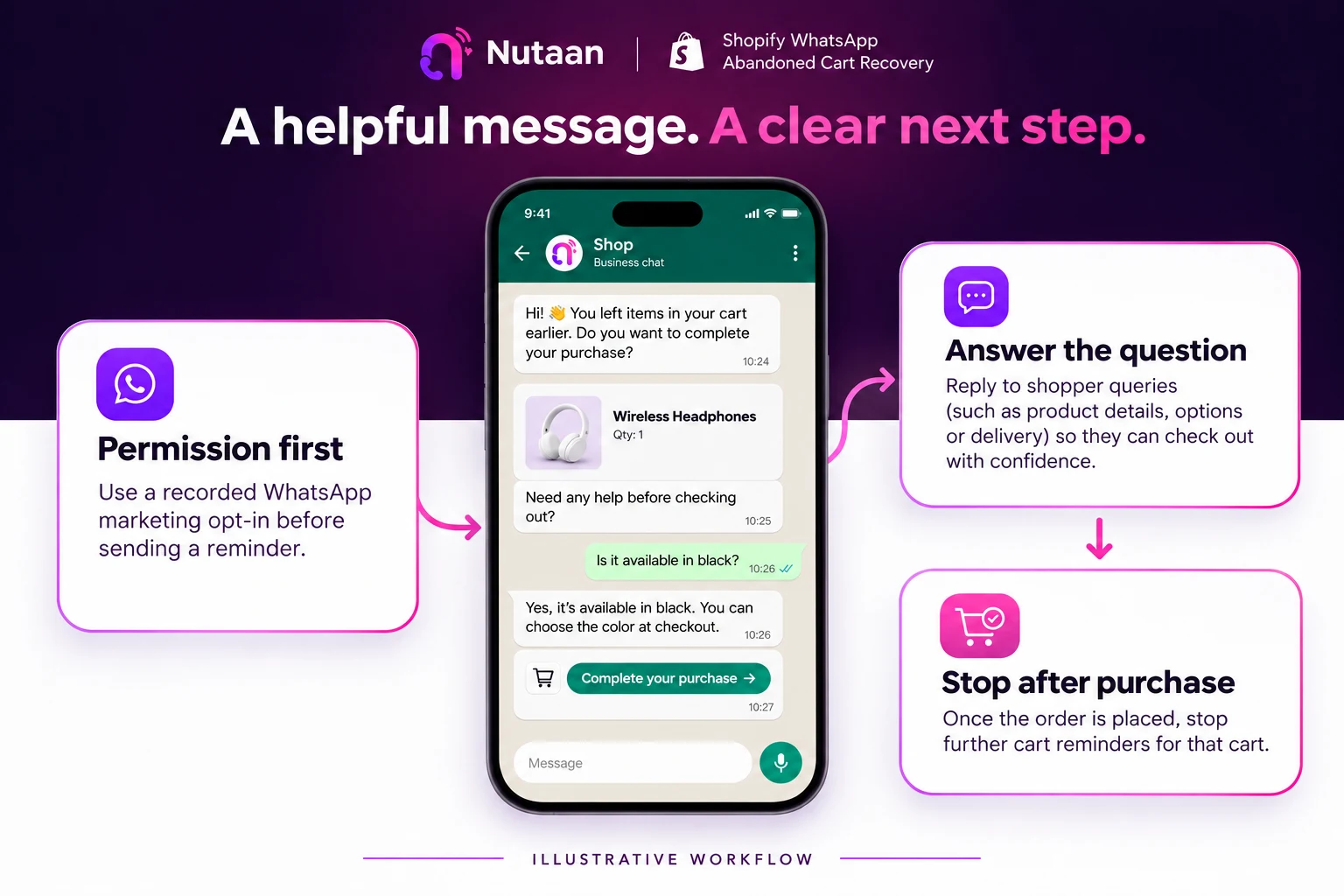
| When the shopper replies | Answer the question or assign a person; pause competing recovery steps. |
| Later review window | Consider one permitted WhatsApp follow-up only if it adds useful assistance. |
| Selected high-margin checkout | Schedule a call only with appropriate permission and a configured calling workflow. |
| Purchase, opt-out or cap | Cancel remaining actions across connected tools and record the reason. |
Keep WhatsApp message intent honest
A reminder encouraging someone to complete an unfinished purchase is not the same as a shipping update for an order already placed. Choose the appropriate message category and template for the intended use. A template approval does not replace permission or local contact requirements.
WhatsApp’s platform pricing information describes delivered-message charges by category and recipient market. Plan for delivery costs and any connected-service charges instead of budgeting a universal per-conversation rate.
Write the message to help: identify the store, explain the context and offer an answer or a checkout link. Do not create false urgency, imply stock is reserved when it is not, or promise a delivery date the store cannot support.
Give a call a different job from an email
A call is useful when a conversation can resolve uncertainty and the margin supports the cost. It should not be an automatic punishment for ignoring a message. Set an eligible audience, caller identity, approved script, language, contact hours and attempt cap.
The agent can explain the store’s published policy or capture a question for the team. It should not invent availability, take card credentials or place the order on the shopper’s behalf. Checkout and payment stay with Shopify.
In Nutaan Commerce, AI recovery calling is an Enterprise feature and requires its dedicated configured workflow. Enabling the shopping assistant or installing the app does not automatically create that journey.
Test the stop rules as carefully as the first message
Create a test checkout and complete its purchase during the wait. Confirm that the queued message and call do not proceed. Repeat with an opt-out, a duplicate checkout, a customer reply needing support and an unavailable variant.
Test a delayed or unavailable integration. Decide whether the workflow should pause rather than contact someone on stale state. Confirm that retrying a job does not create duplicate sends and that a staff member can see the pending action.
Treat opt-outs at the appropriate customer and channel scope. Document what is shared across your systems, who maintains it and how a manual send is checked. Do not assume a stop request inside one inbox instantly updates every external campaign tool.
A hypothetical two-channel handoff
A shopper leaves a high-margin jacket checkout and receives one permitted message after the configured wait. They reply asking whether the size exchange policy covers an opened package. The workflow pauses and a team member clarifies the policy. No call is scheduled while that question is unresolved.
If the shopper then purchases, all remaining recovery actions stop. If they request a call and contact is permitted, the team uses the configured calling workflow at the agreed time. The result is recorded against the checkout, without assuming that the eventual purchase was caused entirely by that call.
Review the programme with margin and customer experience
Report delivery, replies, qualified questions, completed purchases, opt-outs and complaints separately. Use a holdout to estimate additional contribution, not just the revenue associated with a tracked link. The ROI guide provides a worked example.
For India, keep any subsequent COD order confirmation in a separate post-order workflow. For the US, evaluate higher-value checkouts rather than assuming a call is profitable for every basket. For the UK, begin with a carefully reviewed, permission-ready pilot.
Review WhatsApp setup and plans, then book a demo with your existing email tools, channel ownership and stop-rule test cases. The goal is one coherent recovery journey, even when several tools are involved.
Written by the Nutaan team from the product workflows and public references linked in this guide. Examples are hypothetical, not merchant results. Configuration, permissions, plan and connected services determine availability. Reviewed 10 November 2026.