WhatsApp Abandoned Cart Recovery for Indian D2C: Timing, Templates and ₹ Costs
Indian shoppers live on WhatsApp, but a cart reminder that breaks Meta’s rules or arrives at the wrong time does more harm than good. Here is a schedule, the message anatomy and the real costs.
The short answer
Send the first WhatsApp reminder within 15–60 minutes of abandonment, only to shoppers who opted in, using an approved template that names the product and offers help — not just a discount. Send at most two or three messages, stop the moment they buy or opt out, and add an AI call for high-value carts or shoppers with a question. Nutaan runs this flow on Shopify — see WhatsApp abandoned cart recovery for Shopify.
Which carts you can message
You need the shopper’s phone number and their permission to receive WhatsApp messages from you — typically an opt-in at checkout. Messages outside a 24-hour customer-service window must use a pre-approved template. Template category matters: a cart reminder is usually a Marketing template; an order or delivery update is Utility. Category affects both approval and price.
Why Indian shoppers abandon
Unsure whether COD is available or how much it costs. Shipping charges that appear only at checkout. UPI or card payment timing out. Size, fit or authenticity questions. Comparing with a marketplace. Simply getting distracted. Your message should address the likely reason, not repeat “you left something behind”.
A send schedule that works
| When | Channel | Message purpose | Stop if |
|---|---|---|---|
| 15–60 minutes | Reminder + offer to help with a question | Order placed or opt-out | |
| 2–6 hours (high-value carts) | AI call | Answer the question; send the checkout link | Order placed, opt-out or no permission to call |
| 24 hours | Answer the common objection (COD, delivery time, returns) | Order placed or opt-out | |
| 72 hours (optional) | Last reminder; incentive only if margin allows | Order placed or opt-out |
Anatomy of a good recovery message
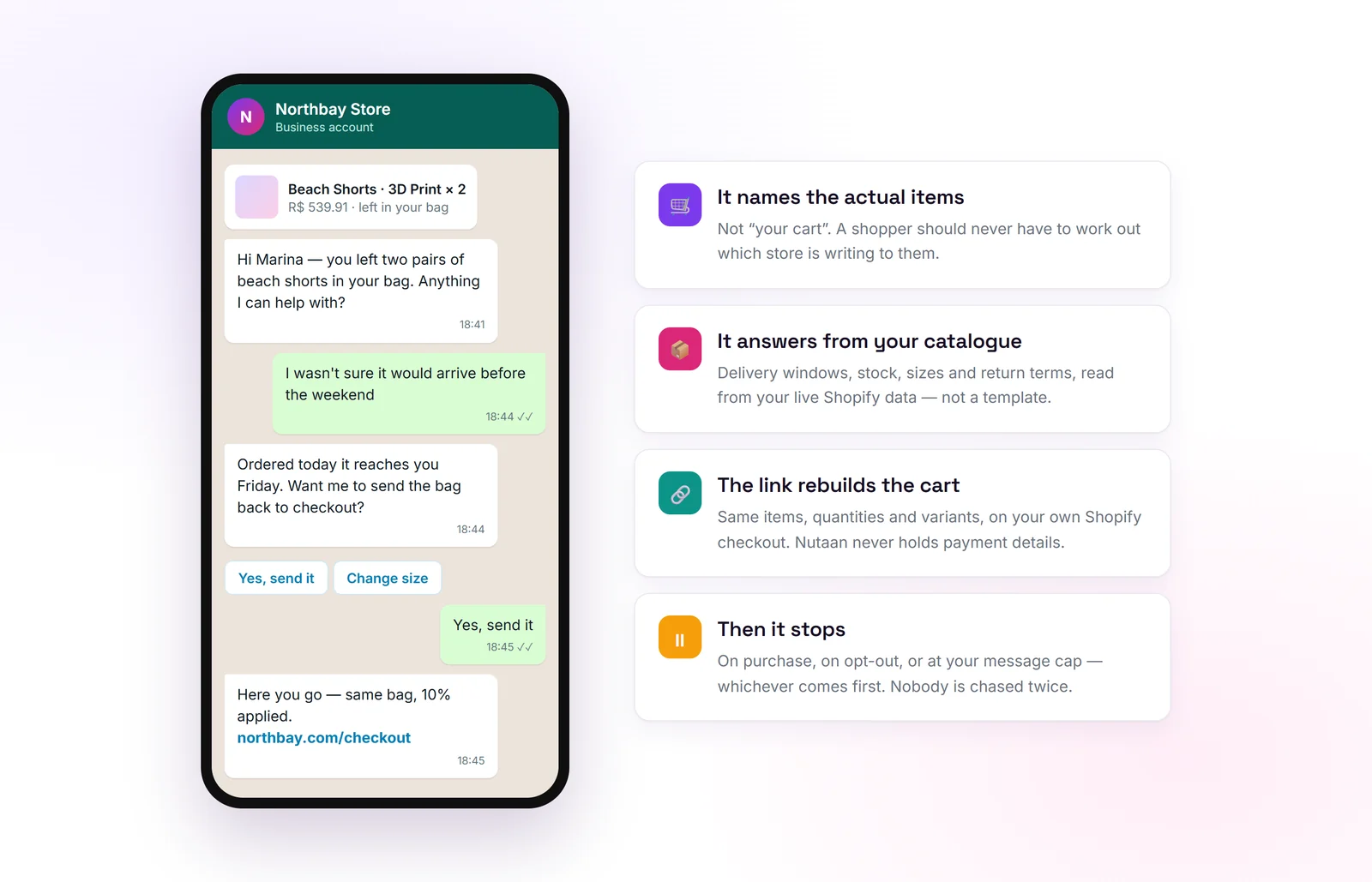
Greeting with the shopper’s first name. The product name and image. One line that helps: “Size doubt? Reply and we’ll help.” or “COD available on this order.” A single button back to their checkout. An easy way to stop. No pressure, no fake urgency.
Three templates to start with
Edit these to your brand voice and get them approved in WhatsApp Manager. Twenty-five more, in Hindi, Hinglish and English with matching call scripts, are in the WhatsApp abandoned cart message templates.
Hi {{1}}, your {{2}} is still in your cart. Any question about size or delivery? Just reply here — we’re happy to help. Complete your order: {{3}}
Hi {{1}}, aapka {{2}} cart mein hai. Is order par Cash on Delivery available hai. Order complete karne ke liye: {{3}}
नमस्ते {{1}}, आपका पेमेंट पूरा नहीं हो पाया। आपका कार्ट सुरक्षित है — यहाँ से दोबारा कोशिश करें: {{2}}
WhatsApp vs AI call vs email vs SMS in India
| Channel | Strength | Weakness | Best for |
|---|---|---|---|
| Read quickly; two-way | Needs opt-in and approved templates; per-message cost | Most carts | |
| AI call | Answers questions live; persuasive | Costs per minute; needs permission and calling hours | High-value carts, questions, COD doubts |
| Cheap; good for images | Lower attention for many Indian shoppers | Repeat buyers, prepaid shoppers | |
| SMS | Reaches every phone | Short; needs DLT templates | Simple reminders |
What it costs: a worked example
Suppose 1,000 abandoned checkouts a month, 70% with WhatsApp opt-in, and two messages each: about 1,400 marketing-template messages. Multiply by the current per-message rate for India on Meta’s rate card (it changes, so check it when you budget). Add AI calls for the top 20% of carts by value — about 200 calls, 60% connect, 1.5 minutes each, roughly 180 minutes, or ₹800–1,100 at ₹4.50–6.00 a minute. Compare the total with the margin on recovered orders.
Measure recovery honestly
Some shoppers would have come back anyway. Keep a small holdout group that gets no messages, and count only the extra orders over that group as recovered. Track revenue, orders, opt-outs and complaints together.
Troubleshooting
Template rejected: remove promotional language from Utility templates and avoid vague variables. Messages not delivered: check opt-in capture and the phone number format (+91). Low replies: make the first line about help, not a discount. Too many opt-outs: send fewer messages.
Frequently asked questions
When should I send the first WhatsApp cart reminder?
Within 15–60 minutes of abandonment, while the shopper still remembers the product.
How many reminders should I send?
Two or three at most, stopping immediately when they buy or opt out.
Do I need permission to send WhatsApp cart reminders?
Yes. Collect opt-in (usually at checkout) and use approved templates for messages outside the 24-hour window.
Should I offer a discount?
Not by default. Answer the shopper’s question first; use an incentive only for later reminders and only if your margin allows.
Does this work for WooCommerce too?
Yes. The same schedule, templates and rules apply; Nutaan supports WooCommerce as well as Shopify.
Written by the Nutaan team — we build and operate the AI calling and chat platform described here, running production voice and chat workloads for businesses across retail, healthcare, real estate, education and hospitality. Updated 19 November 2026. Pricing figures reference Nutaan's published rates; costs on other platforms vary. Questions or corrections: avishek@nutaan.com.