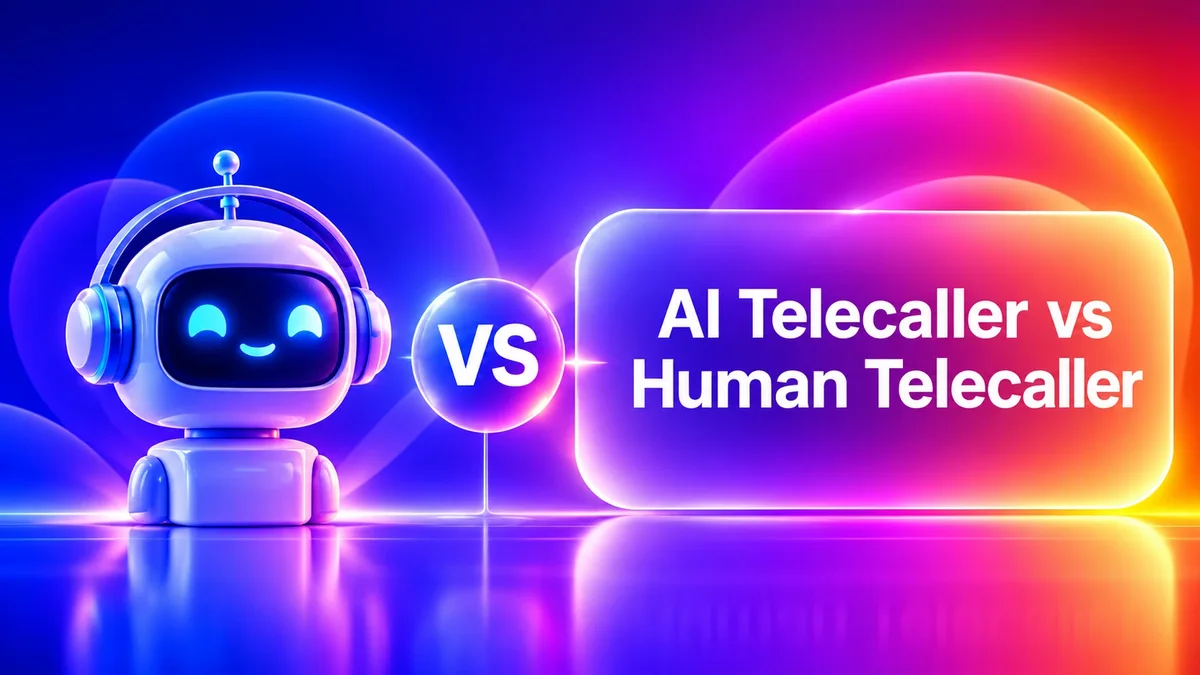
AI Telecaller vs Human Telecaller: Cost, Calls per Day and When to Use Each
AI telecallers win on speed, consistency and cost per call. Humans win on judgement and relationships. Most Indian sales teams that do this well use both — here is how to split the work.
The short answer
Use an AI telecaller for the first call to every lead, for follow-ups after no answer, reminders and re-engagement — the repeatable calls where speed and consistency decide the result. Keep human telecallers for buyers who are ready, negotiation, complaints and anything sensitive. The two together beat either alone.
What each one actually does in a day
A human telecaller’s day is mostly dialling. Numbers ring out, phones are switched off, people say “call me later”, and the real conversations are a fraction of the dials. Notes are typed between calls or at the end of the shift, and leads that arrive after hours wait for the next morning.
An AI telecaller does the dialling, retrying and note-taking in parallel. Every lead is called while it is fresh, every “call me at six” becomes a scheduled callback, and every conversation produces a transcript, a summary and a hot/warm/cold label. The people on your team start the day with a list of interested buyers instead of a list of numbers.
Side by side
| AI telecaller | Human telecaller | |
|---|---|---|
| Speed to first call | Within a minute, inside calling hours | Depends on workload; often hours |
| Parallel calls | Many at once | One |
| Working hours | Every day in your calling window | Shifts, leave, attrition |
| Languages | Hindi, Hinglish, English, regional | Those the person speaks |
| Consistency | Same script every time | Varies |
| CRM notes | Automatic | Manual |
| Reading a hesitant buyer | Limited — hands off | Strong |
| Negotiating price or terms | No | Yes |
| Handling an angry customer | Hands off | Yes |
What each costs per month
A human telecaller costs a monthly salary plus statutory contributions where applicable, a seat, a phone line, training and supervision, and the recurring cost of hiring when people leave. Count all of it, not just salary.
An AI telecaller costs connected minutes. On Nutaan that is ₹6.00 a minute up to 1,000 minutes a month, ₹4.50 to 2,000, ₹3.40 at 5,000 and ₹3.00 at 10,000 (GST extra). A 3-minute qualification call is about ₹18 at the start and about ₹9 at volume. The full method for estimating a bill is in AI calling agent price in India.
The more useful comparison is cost per qualified lead or booked visit, because the AI also changes how many leads you reach at all.
Where humans still win
Buyers making a large decision who want to feel heard by a person. Negotiations where the price or terms are not fixed. Complaints, refunds and anything emotional. Relationship accounts where the customer expects the same person each time. These are exactly the conversations your telecallers have more time for once the AI takes the first call.
The hybrid model Indian sales teams use
Step 1: the AI calls every new lead within a minute, qualifies budget, need and timeline, and books the next step. Step 2: hot leads go to a named person with the transcript; warm leads get a WhatsApp and a follow-up call; cold leads are re-checked in 30 days. Step 3: your team calls the hot list first and closes.
Kolkata developer Sree Balaji Group ran it this way on Diwali day 2026: 463 AI calls, 202 conversations mostly in Bengali, 35 qualified buyers passed to the sales team (case study).
A two-week pilot plan
Week 1: pick one lead source, write a 5–6 question script, run 100 calls, read every transcript and fix what confused callers. Week 2: run the full source for the week alongside your team, and compare speed to first call, conversations per 100 leads, qualified leads and cost per qualified lead against the previous month.
Frequently asked questions
Can an AI telecaller replace my telecalling team?
Not fully. It takes the first call, retries and reminders; people still handle ready buyers, negotiation and complaints.
Is an AI telecaller cheaper than a human?
Per call, usually yes, because you pay only for connected minutes. Compare cost per qualified lead to be fair.
Do customers mind talking to an AI?
Most mind slow or repeated calls more. Disclose that it is an automated assistant, keep calls short and useful, and offer a person on request.
Can the AI telecaller speak Hindi?
Yes — Hindi, Hinglish, English and Indian regional languages.
Written by the Nutaan team — we build and operate the AI calling and chat platform described here, running production voice and chat workloads for businesses across retail, healthcare, real estate, education and hospitality. Updated 19 November 2026. Pricing figures reference Nutaan's published rates; costs on other platforms vary. Questions or corrections: avishek@nutaan.com.